Showing posts with label art history. Show all posts

Tuesday, June 5, 2012

Schiele Shilling Now?

 Shortly after joining Tumblr, I realized that an amazing, non mainstream artist I discovered a long time ago in college is not as secret now as it seemed to us back then. You may have guessed I'm talking about Egon Schiele, whose name, art and signature is now being used to hawk cosmetics.

Egon Schiele - 1912, Two Seated Female Nudes
The cosmetics company purports to take its 1910 Vienna seriously, even recreating make up from  Schiele's works--for a trade show. The logo (Schiele's signature) is a nice touch too. Could these people actually create anything? I doubt Egon was worrying about makeup colors during his short, turbulent life that produced some of the greatest drawings in art history.


"This exquisite line of cosmetics has been inspired by the great art of the famous Austrian Expressionist, Egon Schiele (1890-1918), who painted sensual beauties in WWI-era Austria. The quality of the Egon Schiele Cosmetics is exceptional, made with minerals beneficial for your skin. The colors have been carefully chosen and developed to perfectly compliment the lustrous hues of Schiele’s paintings and drawings. Application of Egon Schiele cosmetics will make you look and feel like the creation of a famous artist. “For the The Makeup Show NYC 2012 we have recreated painting by Schiele painted in 1912. Exactly 100 years ago. We carefully recreated all the colors and specifically the makeup of our model.”

I naively thought works of art had 95 years or so before falling into the public domain, where they can be used for crass and commercial ends by crass and commercial marketers. Your thoughts?

Tuesday, October 11, 2011

Back from Rome and Brittany

Roman kitties relaxing in the shade of Largo di Torre Argentina, the square where Julius Caesar is thought to have been assassinated.
 Really good pizza bianca (no tomatoes) here, which everyone eats standing around outside the shop. The cakes and cookies looked divine. So much wonderful food, so little time! Vegetable filled treats are available everywhere in Rome, unlike in France where if you're lucky you'll find a "simple" cheese sandwich without the ham. It's still delicious though.

 Two of the three fountains in the Piazza Navona. Bernini strikes again!

 The Pantheon was amazing, and Raphael's tomb is here. I learned so much...

 The Ghetto neighborhood has a lot of artsy little shops.

And lots of cool fragments lying negligently around.

This was part of our first day in Rome--I'm planning to post much more about this wonderful trip, and get back to posting regularly (it has been a month since last time). 
Thanks to everyone who is still reading my blog!


Tuesday, August 31, 2010

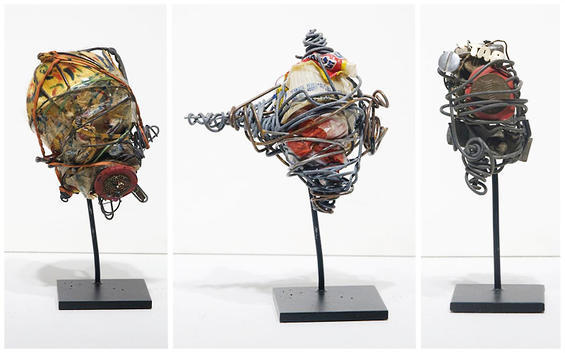
Philadelphia Wireman


Have you heard of the mysterious outsider artist, Philadelphia Wireman? Basically, he (or she?) wrapped everything in wire...No one knows who he was, just that 1200 small sculptures of his were abandoned in a Philadelphia alleyway in 1982, where they were found by an art student.

Fleisher-Ollman Gallery which received the works writes:

The Philadelphia Wireman sculptures were found abandoned in an alley off Philadelphia’s South Street on trash night in 1982. Their discovery in a rapidly-changing neighborhood undergoing extensive renovation, compounded with the failure of all attempts to locate the artist, suggests that the works may have been discarded after the maker’s death. The entire collection totals approximately 1200 pieces (and a few small, abstract marker drawings, reminiscent both of Mark Tobey and J.B. Murry) and appears to be the creation of one male artist, due to the strength involved in manipulating often quite heavy-gauge wire into such tightly-wound nuggets. The dense construction of the work, despite a modest range of scale and materials, is singularly obsessive and disciplined in design: a wire armature or exoskeleton firmly binds a bricolage of found objects, including plastic, glass, food packaging, umbrella parts, tape, rubber, batteries, pens, leather, reflectors, nuts and bolts, nails, foil, coins, toys, watches, eyeglasses, tools, and jewelry.

Heavy with associations — anthropomorphic, zoomorphic, and socio-cultural — to wrapped detritus, the totemic sculptures by Philadelphia Wireman have been discussed in the context of work created to fulfill the shamanistic needs of alternative religions in American culture. Curators, collectors, and critics have variously compared certain pieces to Classical antiquity sculptures, Native American medicine bundles, African-American memory jugs, and African fetish objects. Reflecting the artist’s prolific and incredibly focused scavenging impulse, and despite — or perhaps enhanced by — their anonymity, these enigmatic objects function as urban artifacts and arbiters of power, though their origin and purpose is unknown. Philadelphia Wireman, whatever his identity, possessed an astonishing ability to isolate and communicate the concepts of power and energy through the selection and transformation of ordinary materials. Over the course of the past two decades, this collection has come to be regarded as an important discovery in the field of self-taught and vernacular art.

One of the theories that I came across about his identity is that the sculptures were abandoned by an artist or student who was discouraged about being rejected from exhibitions.

Monday, August 16, 2010

Precursor of Lady Gaga?


Baroness Elsa von Freytag-Loringhaven (1874-1927) was an obscure Dada poet-artist who finally emerged into the mainstream after 80 years. She had her first gallery exhibition at Francis M. Naumann in 2003, with five of her remaining eight existing works on view. A biography by Irene Gammel was published, examining the baroness's iconoclastic writings and filling us in on all the salacious details of her wild and remarkable life.

She single-handedly presented futuristic fashion to the bohemians of Greenwich Village, scandalizing her neighbors by parading semi-nude along 14th Street, barely covered with feathers....Courageous to an insane degree, Elsa was able to provoke and challenge everyone. She recited her poetry on the street, to passers-by, wearing nothing but tea-balls on her breasts. She was feared and admired in verse by the likes of Ezra Pound, Hart Crane, William Carlos Williams, Wallace Stevens and Djuna Barnes. Elsa's death by gas in 1927 at her home in Paris left her friends wondering if it was an accident or suicide.
Artnet.com

Baroness Elsa von Freytag-Loringhoven (German, 1874-1927). Cathedral, 1918

Baroness Elsa von Freytag-Loringhoven (German, 1874-1927). Limbswish, ca. 1917-1918